
The Big Picture:
Changing guitar strings
It is a basic maintenance task that every guitarist should know how to do.
Fresh string make your guitar sound come alive. If you’ve had strings on for a long time you’ll notice the difference right away when you put on new strings. New strings will also help keep your instrument in tune.
Why It Matters:
If you’ve never change your strings or it’s a brand new guitar. Take your instrument into a guitar shop or luthier to have them do a “setup”. The expert will put on new strings but also adjust the neck of the guitar so that it is easy to play.
When changing your guitar strings get used to the same brand and set number and use that string set every time. If you’ve had the neck adjusted you don’t want to jump from a heavy set to a light set. On an acoustic instrument this set below is the Elixir brand and the gauges are 12 on the top and 53 on the bottom side.

Here’s a step-by-step guide to help you change your own guitar strings:
What You’ll Need to Change Guitar Strings:
- New guitar strings: Make sure you’re using the correct gauge for your guitar.
- Guitar tuner: To tune the new strings once they’re on.
- Wire cutters: To trim the excess string length.
- Peg winder (optional): Makes winding the strings faster.
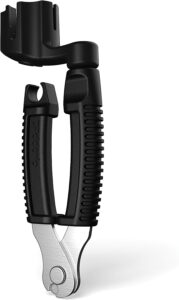
The following peg winder is helpful. It comes with a wire cutter on one end, and is a winder to help tune up your guitar.
Steps:
1. Loosen the Old Strings:
Use a guitar winder or turn the tuning pegs to loosen the tension of the old strings until they are completely slack. Once they are loose, unwind them from the tuning pegs.
2. Remove the Old Strings:
Carefully unwind the old strings from the tuning pegs and remove them from the guitar. You might need to remove bridge pins if you have an acoustic guitar.
3. Clean Your Guitar:
While the strings are off, it’s a good time to clean your guitar. Use a clean, dry cloth to wipe down the fretboard, body, and other parts of the guitar.
4. Install the New Strings:
Start by inserting the ball end of the string into the bridge (for acoustic guitars) or through the tailpiece (for electric guitars). For acoustic guitars, you might need to put the ball end of the string into a bridge pin hole and push the pin back into the bridge to secure the string.
5. Thread the Strings Through the Tuning Pegs:
Pull the string through the bridge and guide it over the nut and into the appropriate tuning peg. Make sure there’s enough slack to wind around the peg.
6. Wind the Strings:
Using a peg winder or your fingers, start winding the string onto the tuning peg. Make sure each coil of the string wraps neatly and doesn’t overlap. Tune the string slightly sharp (higher than the desired pitch) before tightening to ensure the wraps settle properly.
7. Stretch and Tune the Strings:
After all the strings are on and roughly tuned, stretch each string gently by pulling it away from the fretboard. This helps the strings settle in and keeps your guitar in tune. Then, use a tuner to fine-tune each string to the correct pitch (E, A, D, G, B, E from low to high).
8. Trim Excess String Length:
Using wire cutters, trim the excess string length sticking out of the tuning pegs. Be careful not to cut too close to the pegs to avoid the string slipping out.
9. Check and Adjust:
After tuning, check the intonation and action of your guitar. If your guitar has a floating bridge, you might need to adjust the bridge tension to ensure the guitar stays in tune.
Congratulations, you’ve successfully changed your guitar strings! Remember, practice makes perfect, and the more you do it, the easier it will become.
0 Comments